
September NEFMC Meeting Highlights

Updated: Sep 17
Fisheries management happens at the New England Fishery Management Council meetings and there is often so much to track. These decisions shape what can happen on the water and trickles into our coastal communities. A lot happens at these meetings and it's a lot to digest. Below you will find updates from the meeting that we think will impact Maine fishing communities most.
Executive Order 14276 Response and 2027 Priorities: September 16, 2026
Background
Executive Order 14276, Restoring American Seafood Competitiveness, directed the regional councils to identify actions that reduce burdens on fishermen and increase domestic production. On July 2, NOAA Fisheries sent the Council a letter asking them to focus on six specific priorities. The Council's executive committee met September 1 and drafted recommendations on each one, and the full Council took those up Wednesday afternoon.
Council staff have roughly 125 staff months available for 2027. Doing everything currently on the list would take somewhere between 180 and 280 months. As Executive Director Cate O'Keefe put it, committing to work the Council can't deliver sets an expectation it can't meet, and that erodes public trust.
The Council voted unanimously to approve the executive committee's recommendations. Two attempts to amend them failed or were withdrawn, so what passed is the memo as written.
What NOAA asked for | What the Council approved | |
Northern Edge scallop access | An amendment for rotational scallop access inside the closed habitat area | Defer the decision to December |
Scallop permit stacking | Reconsider taking on a stacking action | Tell NOAA the Council doesn't have capacity in 2027, and note NOAA may act on its own |
Herring industry-funded monitoring | Initiate an action to rescind IFM from the Herring FMP | Fold it into the ongoing river herring and shad action, targeting April 2027 |
Ropeless gear | Deprioritize advancing gear marking requirements | Pause activity and monitor NOAA's request for information and pending legislation |
Vessel baselines | A joint framework with the Mid-Atlantic Council | Receive the report now, consider a joint action in December |
Great South Channel habitat area | A framework allowing surfclam dredging based on updated cod spawning data | Receive the evaluation report now, consider prioritization in December |
Four of the six were deferred or paused. One was a formal decline. Herring IFM is the only item where the Council acted this week.
One thing worth watching that was was brought up in discussion around these recommendations:
Groundfish monitoring. Industry was told this summer that the federal appropriations that have reimbursed at-sea monitoring costs since 2018 will be spent during the 2027 fishing year. If coverage defaults to the 40% target in Amendment 23, one Council member estimated a cost equal to 15% of gross revenues and warned that day boats and sector entities would not survive it. A motion to add groundfish to the rescission of IFM herring monitoring request was withdrawn after members agreed on the problem but not the vehicle. Revisions to the Amendment 23 monitoring system are on the draft 2027 list as a new, multi-year action for December.
December is when the Council sets its 2027 priorities and decides what it can actually take on. You can read NOAA's request and the Council's recommendations here: NOAA's July 2 letter to the Council and Executive Committee recommendations.
Scallop Framework 42 and Work Priorities: September 16, 2026
Framework 42 Background
The Council started Framework 42 in June 2026 with two pieces. The first would let the Council hand out Limited Access days-at-sea separately for the Mid-Atlantic and Georges Bank, split at the 71°W line. This split would try to split effort so that one region isn't fished harder than the other as overfishing occurred on Georges Bank in 2023. The second would divide the Northern Gulf of Maine into two sub-management areas, aimed at pulling effort off Stellwagen Bank and spreading it to other banks and ledges that hold scallops but produce lower catch rates.
Separately, a newer idea came up at last week's Advisory Panel and Committee meetings: a tool to limit how much time a vessel can spend fishing inside a closed access area, meant to address high grading and scallops killed on the bottom from towing too long on dense beds.
Two motions came to the Council and both failed, which means Framework 42 moves forward unchanged.
The two were connected. The idea was to drop the regional days-at-sea work and put that staff capacity toward the access area time tool instead. The Council rejected both halves of that trade.
The first motion would have discontinued regional days-at-sea development while keeping the Northern Gulf of Maine sub-areas.
The second motion would have added the access area time limit to the 2027 work plan. It failed with no votes in favor. Members argued the problem needs defining before the tool does, and pointed out that a white paper on fishing practices and high grading is already in the draft 2027 work plan.
Industry was genuinely split on regional days-at-sea. The concern raised repeatedly was that a regional split could lock vessels into an area where the scallops aren't. For Maine, the piece to watch is the Northern Gulf of Maine sub-management areas, which survived intact and keep moving. Framework 42 goes back to the Advisory Panel and Committee in November, with final action expected in the spring. You can read the draft alternatives here: Scallop Framework 42 Discussion Document
Vessel Baseline Restrictions: September 16, 2026
Vessel Baseline Restrictions Background
Vessel baseline rules cap how much a vessel can grow in both length and horsepower. The limit is capped at no more than 10% beyond the permit's baseline length and 20% beyond its baseline horsepower. They date to an era when fishing effort controls, like how big your vessel was, not annual catch limits, were the main tool for limiting catch, and they still apply to most limited access fisheries in the region. The Councils asked staff to evaluate them in 2026 in response to Executive Order 14276 on restoring American seafood competitiveness, after fishermen reported trouble finding replacement vessels and engines that fit within their baselines on their permits.
The Council voted by consensus to accept the report as complete, satisfying its 2026 work priority
Council staff walked through the final report that they developed jointly with the Mid-Atlantic Council and GARFO. Here are some key findings:
1,167 vessels carried baseline restrictions in 2025
Smaller boats are the most constrained with 59% of vessels in the 31-60 foot range sit within five feet of their maximum allowable length
Advisory Panel and public comment raised safety at sea concerns for smaller vessels and the cost and availability of new vessels that fit within their permit are hard to match up.
This is on the Council's draft priorities list heading into December, and the Mid-Atlantic takes up the same report at its October meeting. If both Councils prioritize it, the report becomes the foundation for a joint omnibus amendment in 2027. You can read the full report here: Evaluation of Vessel Baseline Restrictions
Atlantic Herring Committee Report Update: September 15, 2026
Atlantic Herring Background
Herring has been the backbone of Maine's bait supply and is also forage for nearly everything Maine cares about: groundfish, tuna, whales, and seabirds. A decade-plus of poor recruitment and shrinking quotas has pushed the lobster fleet toward pogies, redfish racks, and imported bait, and made every specifications cycle a supply question as much as a science question.

Herring is managed through a single annual catch limit divided into sub-ACLs (catch limits) across four management areas, historically set every two years. The stock is overfished, though overfishing is not occurring, and it has been under a rebuilding plan since 2022. Since then the Council has run two catch setting packages (2023-2025, and then 2025-2027) and issued an in-season adjustment partway through 2025. These are signs of how little margin is left. The 2026 ACL is 9,134 metric tons which is about 20.1 million pounds, with 2,640 mt of that in Area 1A.
The Council sets that Area 1A number, but the ASMFC's Atlantic Herring Management Board decides how it gets spread across the season through the "days out" process, including weekly landing limits. So the quota decided in Plymouth gets shaped again at a the next ASFMC meeting.
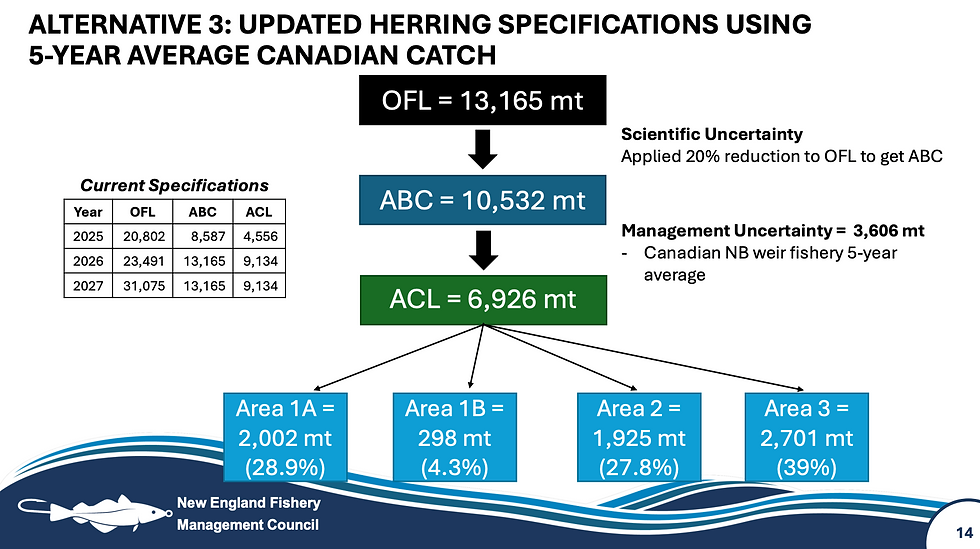
The Council took final action on herring specifications for 2027-2031, adopting Alternative 3 and submitting the specifications document to NOAA Fisheries.
2026 (current) | 2027-2031 (adopted) | |
OFL | 23,491 mt | 13,165 mt |
ABC | 13,165 mt | 10,532 mt |
Mgmt uncertainty buffer | 4,031 mt | 3,606 mt |
ACL (catch limit) | 9,134 mt | 6,926 mt |
Area 1A | 2,640 mt | 2,002 mt |
The options the Council was voting on were between Alternative 2 which used a 10-year average of Canadian catch (5,131 mt buffer, ACL of 5,401 mt, a 41% cut) and Alternative 3 used a 5-year average (3,606 mt buffer, 24% cut). The rationale for the shorter length of data centered on 2018, when Canadian catch topped 13,000 mt, an outlier that Council members argued skews the 10-year average well above anything seen from 2021 to 2025. Another Council member said he'd support a 5-year average regardless of which direction it pushed the quota, because shifting stock distribution and changing ocean conditions make recent data more representative.
ASMFC's Herring Board must set its specifications in November in Newport, Rhode Island. Implementation targets the start of the fishing year which is January 1.


Comments